AWS A2.4 §6.9 · D1.1:2025

Field Weld Symbol

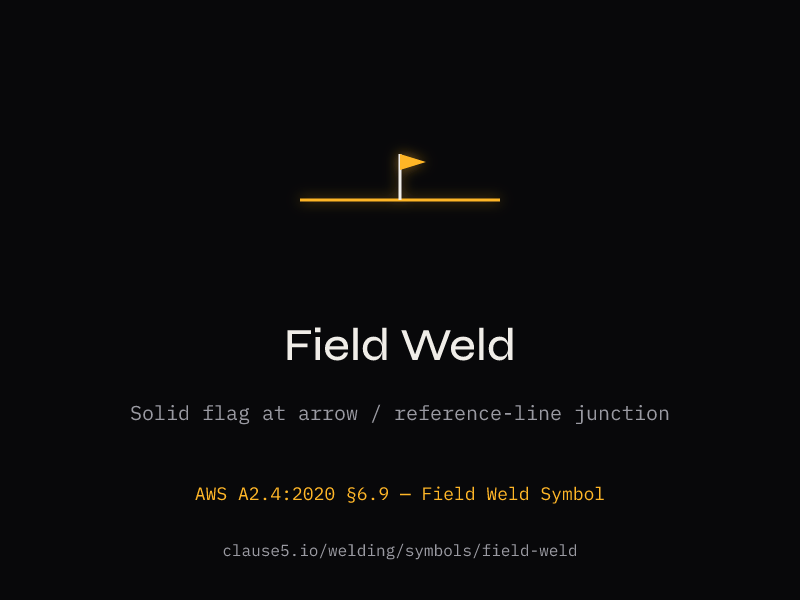
Field weld symbols use a solid triangular flag at the arrow-reference junction to mark welds made during erection, not in the shop. The flag is supplementary; weld type, size, and side still come from the primary symbol, dimensions, and code-qualified procedure requirements.

How to read the field weld flag — placement at the arrow junction, shop vs field weld distinction, and D1.1:2025 field welding requirements.
Ask Flux
Field Weld Symbol — Anatomy
5/16 flag at junction
Field weld + fillet
+ weld-all-around
Field + all-around
field V-groove CJP
Field + V-groove
Key rule: The field weld flag is a solid triangle at the arrow-reference line junction. It sits at a right angle to the reference line. The flag is a supplementary symbol; weld type, size, and side remain defined by the primary symbol and associated dimensions.

Shop Weld vs Field Weld

In structural steel construction, members are fabricated in the shop (factory) and then assembled at the erection site (field). The field weld flag on a drawing tells the welder and inspector that this particular joint is to be welded on-site, not during shop fabrication.

Why the Distinction Matters

Shop welds are made under controlled conditions — overhead cranes for positioning, consistent temperature, wind protection, and full equipment access. Quality control is typically more streamlined.

Field welds face additional challenges: weather exposure (wind disrupts shielding gas coverage), limited access (welding in difficult positions), ambient temperature concerns (cold weather affects preheat and interpass temperatures), and inspector access considerations.

Per D1.1:2025, the same quality standards apply to both shop and field welds. The field weld flag does not change acceptance criteria — it alerts the erection team and inspection personnel that this joint requires field attention.

Combined symbols: The field weld flag can appear with the weld-all-around circle at the same junction point. Both are supplementary symbols that modify the primary weld — the flag specifies location (field), the circle specifies extent (all around).

Field Weld Flag vs Dashed Symbol Elements

Field weld questions often mix two different ideas: the field weld flag and dashed symbol elements shown in other contexts. Per AWS A2.4 §6.9, a flag specifies a field weld and is placed at a right angle at the arrow-reference-line junction. It indicates where the weld is made (field, not shop).

Dashed elements can appear in other symbol or detail contexts, but they are not the field weld flag. A practical check is simple: if it is not a solid triangular flag anchored at the arrow-reference junction, do not classify it as a field weld indicator. This avoids wrong execution scope, inspection timing mistakes, and drawing interpretation errors.

FeatureField Weld FlagDashed Symbol Element
Visual formSolid triangular flagDashed line or mark pattern
Anchor pointArrow/reference-line junctionVaries by symbol/detail context
MeaningWeld performed in fieldContext-specific notation
ControlsLocation and execution contextInterpreted from specific detail rule
Common mistakeTreated as weld type indicatorMisread as field weld flag

"On drawing reviews, the fastest way to avoid rework is to separate location symbols from geometry symbols. The field flag answers where the weld is made. The base symbol answers what weld to make."

— CWI field observation

For execution checks after symbol interpretation, use NDE requirements guidance to align inspection scope with weld location and process constraints.

Field Welding Conditions

D1.1:2025 Clause 7 governs fabrication requirements including field welding conditions. Field welds must satisfy the same procedural requirements as shop welds, with additional environmental considerations.

Requirement Detail Source
Min temperature 0°F [−20°C] ambient — welding not permitted below this Clause 7.11.2
Wind protection GMAW, GTAW, EGW, FCAW-G require shelter reducing wind to max 5 mph [8 km/h] at the weld Clause 7.11.1
Preheat Same Table 5.11 requirements — ambient cold may require higher preheat to compensate Clause 5
Acceptance criteria Same as shop welds — visual and NDE acceptance criteria both in Clause 8 Clause 8

Field welds face more variables than shop welds — wind, temperature, fit-up tolerances, and limited access. That is why field welding typically requires the inspector who verifies code compliance to be present during critical operations, not just for final acceptance.

Field Weld Symbol FAQ

What is a field weld symbol?
A field weld symbol is a solid triangular flag placed at the junction of the arrow and the reference line of a welding symbol. Per AWS A2.4 §6.9, it indicates the weld is made at the erection site, not in the fabrication shop. The flag sits at a right angle to the reference line and acts as a supplementary location indicator. It does not define weld size, weld type, contour, process, or side significance. Those remain defined by the primary weld symbol, dimensions, and notes attached to the same reference line. In practice, read the base weld symbol first, then apply the field flag as the execution-location modifier for fabrication and inspection planning.
What is the difference between a field weld and a shop weld?
A shop weld is completed in the fabrication facility where fit-up control, weather protection, positioning, and handling are typically more predictable. A field weld is completed at the erection site where wind, access limits, sequence pressure, and temperature variation can increase execution risk. D1.1 does not reduce quality expectations for field welds; acceptance still follows Clause 8 criteria. What changes is the execution environment and controls needed to achieve that quality. For example, Clause 7.11 adds field-condition limits such as wind protection for selected gas-shielded processes and minimum temperature restrictions in the weld vicinity. So the distinction is location and process control, not lower acceptance standards for finished weld quality.
Where is the field weld flag placed on the symbol?
The field weld flag is placed at the arrow-reference-line junction, drawn as a solid triangular flag at a right angle to the reference line. This location is critical because that junction is where supplementary symbols modify the base weld instruction. The flag may be shown with other supplementary symbols, including weld-all-around, but each symbol keeps a separate meaning. Side significance still comes from where the primary weld symbol is placed relative to the reference line, not from the flag itself. During reviews, confirm three items in order: base symbol meaning, dimensions and notes, then supplementary indicators such as the field flag. That sequence prevents location symbols from being misread as geometry or size instructions.
Does D1.1 have different requirements for field welds?
No. The field weld flag changes where the weld is executed, not the acceptance criteria used to judge weld quality. D1.1 places visual and NDT acceptance criteria for non-tubular connections in Clause 8 Part C (§8.7), and all welds still require visual inspection to Table 8.1 or Table 10.14 as applicable (§8.9). Field welding does add execution controls in Clause 7, including wind shelter limits for GMAW, GTAW, EGW, and FCAW-G (§7.11.1) and minimum temperature restrictions in the weld vicinity (§7.11.2). In short, the flag is a location and planning instruction that affects how work is performed in the field, while acceptance remains governed by the same Clause 8 criteria.
Is the field weld symbol a dashed line?
No. The field weld symbol is a solid triangular flag at the arrow-reference junction, and it specifically communicates field execution rather than shop execution. Dashed elements may appear in other symbol systems or detailing conventions, but they should not be assumed to mean field weld unless the governing symbol convention explicitly says so. Use a fixed reading order: identify the primary weld symbol, read dimensions and supplementary symbols, then check notes and nearby details for context. If a mark is dashed, offset, or detached from the arrow-reference junction, treat it as a separate notation until confirmed. This discipline prevents fabrication routing errors, wrong sequence planning, and avoidable inspection hold points.
How do I tell a field weld flag from other symbol marks on a drawing?
Use shape plus anchor point together. A field weld flag is a solid triangle attached at the arrow-reference-line junction. If a mark is dashed, displaced, or not connected at that junction, do not classify it as a field flag until the applicable drawing convention confirms that meaning. Next, verify context: the base weld symbol still defines weld type and side, while dimensions and notes define size, length, pitch, and process constraints. Field flags primarily alter execution location and inspection planning. Applying this sequence avoids common review failures such as routing shop work to field crews, assigning wrong hold points, or mislabeling symbol geometry as erection-stage instruction. Always cross-check with the weld detail and governing project symbol standard before release.
Does a field weld flag change D1.1 acceptance criteria?
No. The field weld flag changes where the weld is made, not the acceptance criteria themselves. D1.1 states that acceptance criteria for visual and NDT inspection of non-tubular connections are in Clause 8 Part C (§8.7), and all welds are visually inspected to Table 8.1 or Table 10.14 as applicable (§8.9). Field conditions add execution constraints, including wind shelter limits for GMAW, GTAW, EGW, and FCAW-G (§7.11.1, max 5 mph [8 km/h] in the vicinity of the weld) and temperature limits at the weld vicinity (§7.11.2, below 0°F [−20°C] not permitted). So the flag is a location/execution marker, while weld acceptance still follows Clause 8 criteria.